
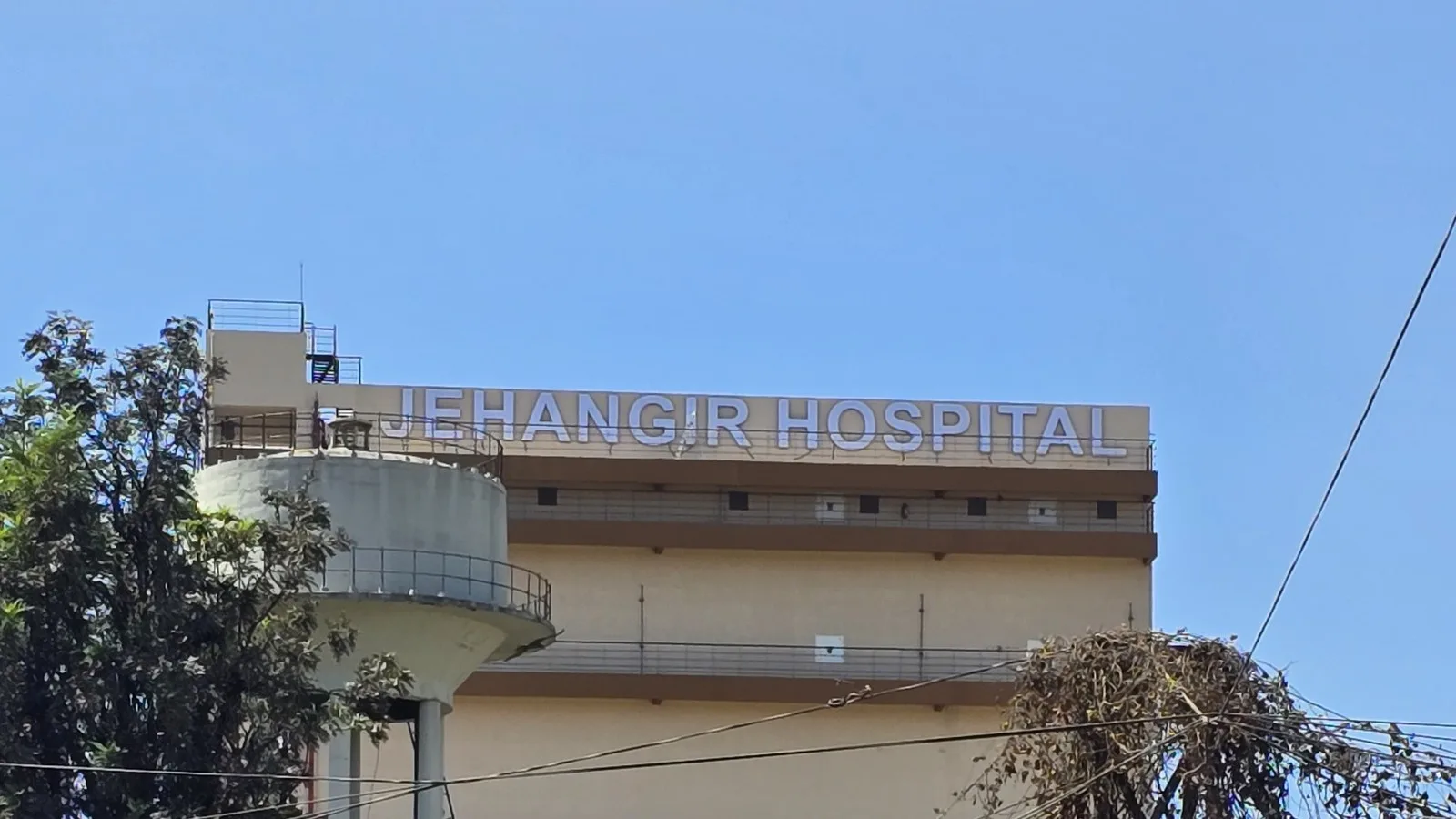
Behind the scenes · Jehangir Hospital, Pune
One of the first signs you see as your train pulls into Pune
Jehangir Hospital, on Sassoon Road, has built a new multi-level car park right beside Pune station. Since February 2026, its top carries the hospital’s name in lit letters, each about as tall as a grown man.
Trains pulling into the station run right past it. For many people arriving in Pune, it is one of the first signs they see. For us it is one of the biggest jobs we have ever done, and a huge feather in our cap. This is the story of how it went up.
Each letter
About 6 ft tall
The sign
91 ft long, on a 98 ft wall
The light
2,105 Osram LED modules
The way up
12 parking levels, no lift

The building
A name on the skyline, by the railway tracks
The car park is a tall concrete building with a parapet wall running around its top. The hospital wanted two signs on it: the English name on the face that looks towards the station and the tracks, and the Marathi name, जहांगीर हॉस्पिटल, on the other face.
The English sign is the one you see here. The Marathi sign is ordered and will go up later this year.

How the job ran, from the first look in February 2025 to the engineer’s report in March 2026.

Before there was a wall
Up an unfinished building, on foot
Our first look at the building was in February 2025, from the roof of the hospital next door. The car park was still rising, with bare steel rebar sticking out of its top and green safety net around it.
To plan a sign, you have to stand where it will go. So, while the building was still under construction, we went up. There was no lift: just scaffold stairs, plank walkways and a long way down. Hard hats on and safety harnesses tied, we climbed past the rebar cage where the parapet wall would later be cast. Sachin from our team led the way; I filmed every step, and my knees remember every one of them.
July 2025
Where eagles dare
These were shot on the way up. The green net is the only thing between the planks and the drop.

On the planks
Sachin on the scaffold walkway beside the bare rebar of the future parapet.

Looking down
The scaffold stairs, looking down from near the top.
Real photos from our climb, 10 July 2025.

Back on top
The view the letters would face
By November 2025 the terrace was finished, with a walkway and railing in front of the parapet wall. Sachin went back up with a hard hat on, and we stood where the letters would go.
That walkway would matter later: it meant we could stand behind the wall and fix the letters by hand, with no gondola.
The height
A long way down
Two views from the top: one over the safety net in July, one from the finished terrace in November, straight down onto the tracks.

July 2025
Over the safety net, straight down onto the roofs below.

November 2025
From the terrace, straight down onto the railway tracks by Pune station.
Real photos, taken by our team.
The board meeting
Two sample letters, and a lot of questions
In late 2025 I was called to present to the hospital’s board of directors and trustees: how I planned to put the letters up, and what they would be made of.
I didn’t want to go in with just slides. So we made two sample letters in exactly the build we were proposing: an English J and a Marathi ज, with the same aluminium, the same LEDs and the same acrylic face as the real thing.
The questions came from every side of the table. How long will it take? How long will it last? What maintenance does it need? What are the chances of it failing? We answered them one by one, with the samples on the table.
At the end of the meeting the board ordered not one but two signs: the English name for one face of the car park, and the Marathi name for the other.
The proposal
Planned on a photo of the building, by day and by night
Before anything is cut, we plan every sign on a photo of the real building: the size of the letters, the length of the line, and how it looks in daylight and after dark. For Jehangir, we showed more than one layout, with and without the hospital’s logo.
In the end the hospital chose letters only, in white, about 6 ft tall, in a single 91 ft line on the 98 ft wall.

Early proposal mock-up: day and night views of one layout on the building (this option had a logo; the final sign is letters only).

Early proposal mock-up: how the sign would read from the station side.
On paper
Sizes and the wall we had
The architect’s drawings marked the top band of the car park as the area for branding. Our dimension slide fitted the letters to it: English letters 71.77 inches (about 6 ft) tall, in a line 1,094 inches (about 91 ft) long, on a wall 30 m (98 ft) wide.

From our proposal: the dimensions of the English and Marathi signs.

The architect’s front and rear elevations, with the area for branding at the top.

The letters
Built to stay up for decades
Each letter is a hollow box of 3 mm aluminium, 4 inches deep, riveted together. Aluminium doesn’t rust, so it can take years of monsoon and summer sun at that height.
The face is 3 mm white acrylic (on a micrometer it reads about 2.7 mm, which is normal for 3 mm sheet). It sits in a 1 mm aluminium trim cap, 1.5 inches deep, that slides over the letter like the lid of a dabba, the same way we built the L&T logo.
Inside, outdoor-grade Osram LED modules are packed tightly across the back of each letter, so the whole face glows bright and even, with no dark patches.

Illustration: one letter cut through, and how it is fixed to the wall. Not to scale.

In our workshop
Twenty-odd days on the workshop floor
Fabricating the letters took about 20 to 25 days in our workshop. The letters were wired and switched on for testing before they were packed.
Our floor is never empty. If you look closely at these photos you’ll spot other jobs in progress around the giant letters: a clinic’s banner, a stencil, a round backlit panel. That’s a normal day at Orchid.
Scale
Letters taller than the team

The O
The letter O standing on its edge, taller than a man.

The floor
Letters laid out across the workshop floor, LEDs in.
Real photos from our workshop, February 2026.

The detail most people never see
Every joint soldered and sealed
Most sign makers twist the wires of a joint together and wrap them in insulation tape. It works on day one. Over time the tape dries and lifts, the twist loosens, the copper blackens, and the letters start to dim or flicker. On a sky sign, that joint is out of reach.
We go the extra mile. Every joint is soldered, so the strands fuse into one wire, then sealed in a heat-shrink sleeve that shrinks tight around it. No air, no water, no carbon, no sparks. We do this on every board we make, not just the big ones.

Illustration: a twisted-and-taped joint next to a soldered, heat-shrink-sealed joint. Not to scale.
Close up
Solder and sleeve

In the workshop
The soldering iron and the LED module chains inside a letter.
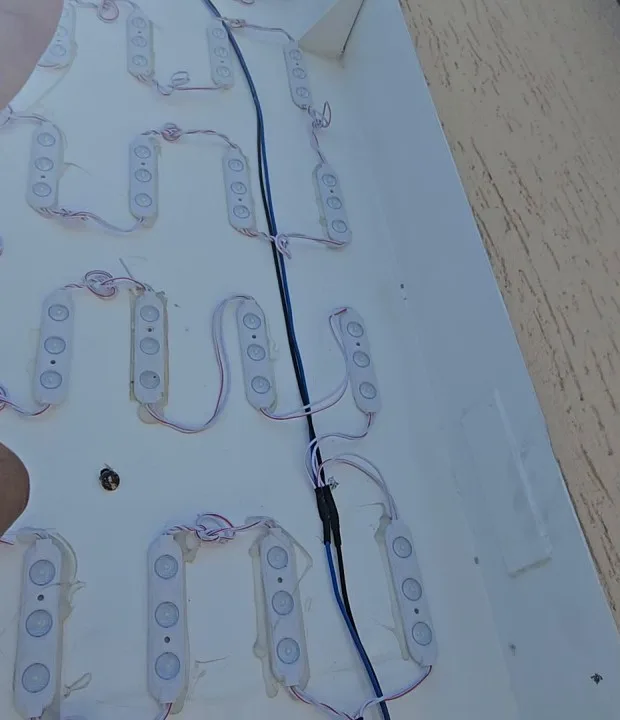
On the wall
Black heat-shrink sleeves on the joints of the feed wires.
Real photos from the job.
Before it was built
What will it cost to run? We worked it out
A sign this size uses real electricity, and the hospital wanted to plan its running cost. Most sign quotes stop at the price of the board. We went further.
We counted every LED module in our letters, 2,105 of them at 1.8 W each, added 10% for losses in the long cable run from the foot of the building, and worked out the load: about 4.2 kW. Lit from 6 pm to midnight, that’s about 25 units of electricity a night. With that, the hospital could plan for the daily running of the sign before a single letter was made.

The load sheet we made for the hospital, redrawn. 1 unit = 1 kWh.

Still no lift
Sixteen 6 ft letters, up 12 levels by hand
Each finished letter was wrapped in bubble wrap and corrugated sheet and loaded onto a truck. At the car park there was still no lift to the top.
So on 26 February 2026 our team and porters carried every letter up the stairs to the terrace, one at a time,. Seven or eight porters did the carrying; Sachin, the team and I went up with them.
26 February 2026
Truck to terrace

Unloading
A wrapped letter coming off the truck at the car park.

The stairs
Carrying a letter up the staircase: there was no lift.
Real photos from the day.

Hands on
One of the rare times I fixed letters myself
Usually I’m the one talking to the client. Not this time. Up on the terrace it was so hot that I ended up in shorts with my T-shirt off, unpacking faces and fixing letters alongside the team.
The wrapped letters stood in a row along the wall, ready to go up.

The wrapped letters lined up on the terrace before fixing.

The fixing
Straight into 300 mm of solid RCC
On many towers, the wall at the top is made of concrete blocks. Screws don’t hold well in blocks, so we first bolt a steel frame into the building’s beams and fix the letters to the frame.
Here the parapet is solid RCC, 300 mm thick, right through. So no frame was needed: each letter is fixed directly into the wall with chemical anchors, threaded studs set in resin inside drilled holes, which hold far better than ordinary screws.
And because there is a walkway behind the parapet, we stood on it and worked by hand. No gondola either.
1
Mark and drill
Mark each letter’s position on the RCC wall and drill the anchor holes.
2
Set the anchors
Set threaded studs in resin in each hole and let them cure.
3
Fix the trays
Bolt each letter’s tray onto its studs, with washers and nuts.
4
Wire and test
Run the wiring, solder and seal every joint, switch on.
5
Fit the faces
Slide the trim cap with its acrylic face over each letter.
27-28 February 2026
Trays on, faces on

Trays first
The letter trays on the wall, faces off, LEDs facing out.

The anchor
A chemical anchor stud, with washer and nut, holding a tray to the RCC.
Real photos from the installation.
Signed off
A structural engineer checked our work
This was one of the rare jobs where the client asked for a certificate. We brought in an outside structural engineer, who reviewed the fixing method before we started and signed his report after the installation, on 3 March 2026.
His findings, in short: the letters weigh 25 to 30 kg each at most, the 300 mm RCC wall gives the anchors plenty of depth, and the chemically anchored letters are stable and safe for their own weight and for wind, as per IS 875: 2015. Light enough not to harm the wall, and fixed firmly enough not to come down.

An extract from the structural audit report, re-set for the web. The engineer’s name and stamp are not shown.

The wiring
One power supply for every letter
The hospital ran its power cable up to a grey weatherproof box at the foot of the wall, one box for every letter. That was the only part of the wiring on their side.
Inside each box we fitted the letter’s power supply (SMPS), and from there ran our cable through the wall into the letter. So each letter can be switched off on its own: a power supply is swapped at the box, and a faulty LED module can be cut out of its chain and a new one soldered in, without taking the letter down.

Illustration: the hospital’s cable, our power boxes and our wiring. Not to scale.
Finished
Up close, on the walkway
From the walkway behind the wall you get a sense of the size: the letters stand well above the railing.
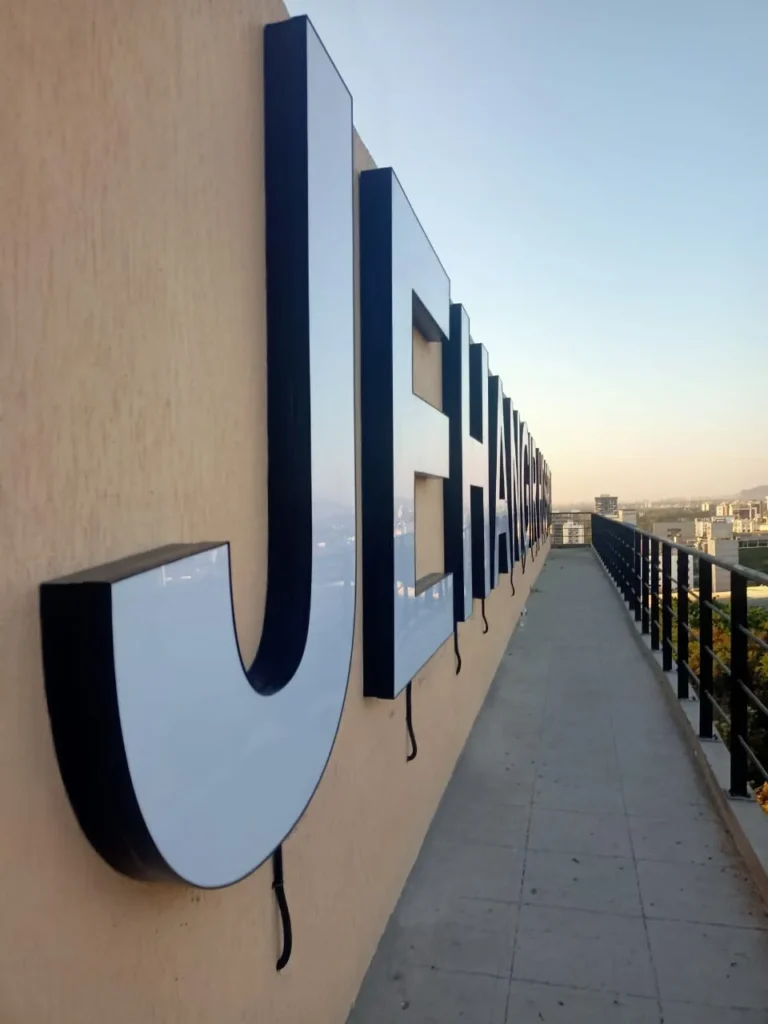
The J
The first letter of JEHANGIR, seen along the walkway.

HOSPITAL
The second word running along the parapet.
Real photos of the finished sign.
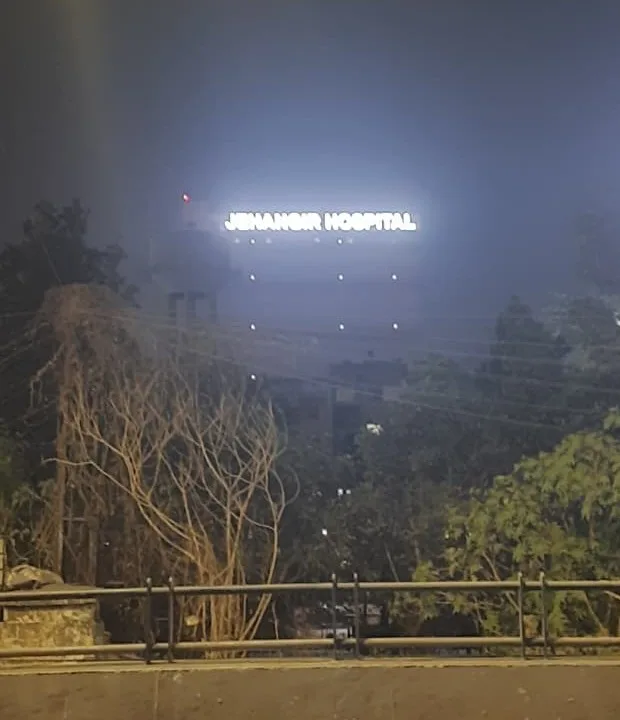
After dark
Lit every night above the station
From 6 pm, the white faces light up evenly across all sixteen letters, and the name hangs over the station area.
This shot is from the flyover across the road.

HOSPITAL along the parapet at dusk, with the city behind.
Watch
The whole job in five minutes
From the proposal to the workshop, the stairs and the installation: our video of the job.
The specs
What went up
Client
Jehangir Hospital, Pune: the new multi-level car park beside Pune station
When
Planned in 2025; installed 26-28 February 2026
Size
16 letters, each about 6 ft (71.77 in) tall, in a 91 ft line on a 98 ft wall
Letters
3 mm aluminium sides, 4 in deep, riveted; 1 mm aluminium trim cap, 1.5 in deep
Faces
3 mm white acrylic
LEDs
2,105 outdoor-grade Osram modules, 1.8 W each; about 4.2 kW in all
Fixing
Chemical anchors straight into a 300 mm RCC parapet; no frame, no gondola
Checked
Structural engineer’s report: 25-30 kg per letter, safe for dead and wind loads (IS 875: 2015)
Scope
Turnkey: proposal, samples, fabrication, transport, carrying up, installation and wiring (licence by the hospital)
Planning a sky sign?
What it takes, and what it costs
Every sky sign is priced for its building: the height, the wall, how we get the letters up, the size of the letters and the LEDs all change the price. So the price comes with the proposal. Price on request.
Good to know
What to send us
A photo of the building, its height, the wall you have in mind and your name or logo.
The licence
A sky sign needs the municipal corporation’s licence. On this job, the hospital took care of it.
Warranty
Six months from installation, as on all our fabricated signs. The bodies, faces and anchors are built to last for decades.
Running cost
Ask us for the load and units per night, as we worked out for Jehangir.
Putting your name on a building? Send us a photo and we’ll make a proposal, with the letters drawn on your own building.
Read more
More sky signs
Lit signs
Sky signs and 3D LED sign boards

All the kinds of lit sign we make, from shop boards to letters for the top of a tower.
See sky signs →Case study
A sky sign at the top of a tower
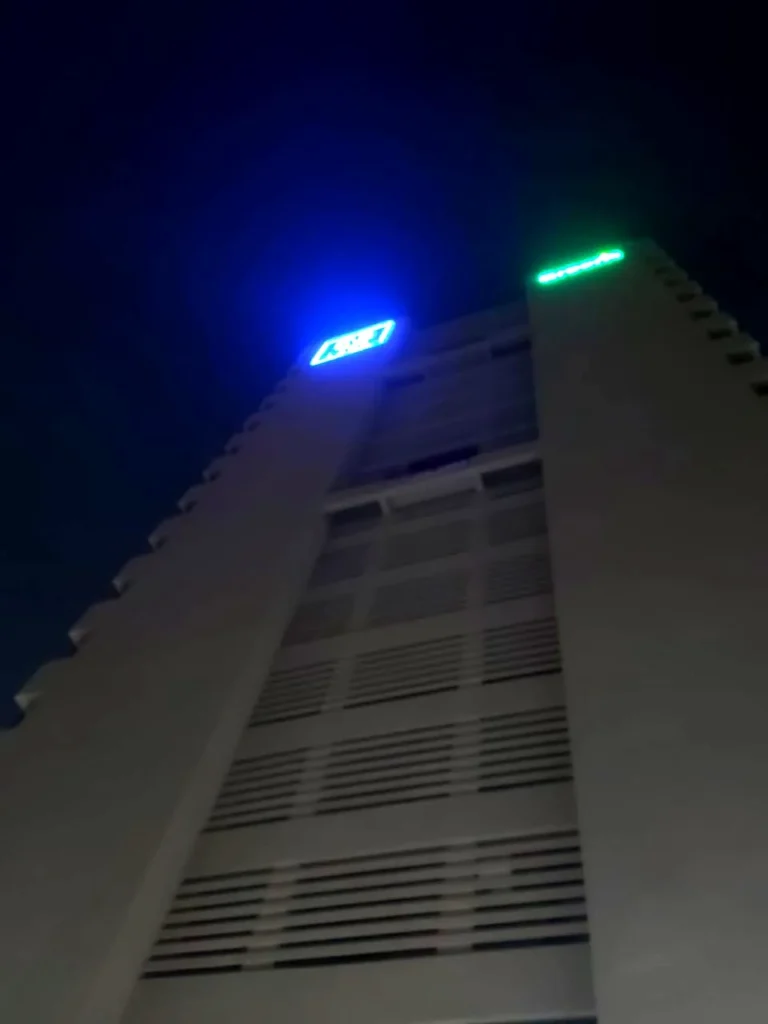
Green’s, Thergaon: a block wall, so a steel frame into the beams and a gondola.
Read the AMJ Land story →Next on this building
The Marathi sign is coming
जहांगीर हॉस्पिटल goes on the other face of the car park later this year, built the same way. We’ll add it here when it’s up.
See every photo on the Jehangir Hospital sky sign job page, or more of our work for hospitals and clinics.
More signs, high up
Our work
AMJ Land’s Green’s, Thergaon

Blue and green lit letters at the top of a residential tower.
See the job →Our work
Hotel Sahara, SB Road

New lit letters on a rooftop sign, readable from a kilometre off.
See the job →Your turn
Want your name on the skyline?
Send us a photo of your building on WhatsApp. We’ll plan the letters, the fixing and the way up.