







August 20, 2020
UV flatbed printing explained: how the machine prints straight onto flat, rigid objects, what UV inks can stick to, and what Orchid Digitals makes with UV printing today.
People are often curious about UV (ultraviolet) printing, and about UV flatbed printers in particular. To understand how a UV flatbed printer works, we first need to look at what conventional printers can and can’t do.
The abilities of any printing machine are defined by the media it can print upon. For example, the home inkjet and laser printers are used for primarily printing on paper.
We then have wide-format inkjet photo printers that can print on rolls of vinyl, canvas, and to a limited extent, cloth. Solvent printers reproduce images on flex hoardings and banners. Finally, the huge offset and digital presses can, in addition to regular paper, print on coated and textured sheets of paper and card sheets.
But if you noticed, specially manufactured media is needed in each of the printing examples cited above.
Wood and pulp need to be pressed into thin sheets of paper. PVC has to be converted to make rolls of flex or vinyl. Cotton fiber has to be woven into cloth or canvas and then tightly wound into rolls. And only then can these media be deployed in conventional printers.
Media (be it paper, plastic or cloth), is specifically made compatible with its intended printer. Only when the media conforms to the requirement of the printing device, (laser, inkjet, offset, etc.) can it be used for the purposes of printing.
The printer sits in its place and sheets of paper / rolls of plastic pass through its innards. Different processes like laser, inkjet, or offset printing takes place, and the print image gets transferred upon the media. The printed media then passes or flows out of the printer and into our hands.
But if this is the case, how would you print on an object that has not been specially manufactured for being printed upon?
Suppose that you want to print on a block of wood or, say, a slab of glass. Have you ever considered pushing a cricket bat made of pine or willow into your home inkjet printer? A sheet of paper curves through the rollers of a laser printer. But how would a sheet of glass do the same?
Have you ever wondered if there is any technology that can print directly onto an object, like a block of marble?
UV flatbed printing does exactly that: it prints directly onto a wide variety of rigid, flat objects. Orchid Digitals ran a small, A3-size Mimaki UV flatbed for several years, when we printed on diaries, pens and small gift items. Those jobs taught us a lot about the technology, but they didn’t suit our business, so we stopped printing on objects. The machines we run today are on our printing infrastructure page, and the UV printing we use now goes into finished products we make (more on that below).
In principle, a flatbed can print on almost any flat object that fits on its bed. The rest of this guide explains how.
Old showcase (2018): an image of Virat Kohli being printed on a cricket bat on a UV flatbed. We no longer print on bats or other objects; the clip simply shows how the machine works.
To understand how a UV flatbed printer is different from the other print machines, we need to go back to our earlier examples of inkjet, laser, solvent, offset, etc. printers. In each of these machines, the media, conforming to a strict set of specifications (like paper size, thickness, uniform flatness, etc.) has to pass in and out of the printer.
Remember, the printer stays in its place. It is the media that is always moving.
But a UV flatbed is constructed differently. It has a bed or table which is stationary. This table also has an inbuilt vacuum suction.
The UV inkjet printing heads are mounted on a gantry that moves along the X and Y axis (length and breadth) of the table. So when you need to print upon an object, you simply place it on the print-bed / vacuum table.
The vacuum suction holds the object in place. This ensures that the object does not shift inadvertently or due to machine vibrations.
Once the printing starts, the gantry moves the print mechanism in the directions of left/right and up / down. The print heads fitted in the gantry, cover the entire area on the print bed. Ink is fired on any object placed on the bed and the same gets printed upon.
Have a look at the above video of an image of Virat Kohli being printed on a cricket bat and the concept of “what is UV flatbed printing” becomes clear.
UV inks as the name suggests getting cured by ultraviolet rays. These inks are sprayed in a liquid form on the print surface. An ultraviolet lamp then passes over the inks and solidifies them in place.
All other printers have inks that are compatible with only certain kinds of media. For example, inkjet inks require coated papers to reproduce high-resolution images. Laser toner cannot adhere well to rough and textured papers.
But UV printing inks are unique in the sense that they are media independent. These inks can be applied to smooth surfaces like plastic or rough surfaces like wood. You can use them to print on stone, ceramics, marble, glass, acrylic, etc. As long as the UV lamps cure the inks properly, they solidify and faithfully stick to just about any rigid surface.
A note on glass: we don’t print on glass. For glass doors, windows and partitions we print on self-adhesive films that are pasted on the glass, such as white-ink glass film and transparent glass film.
Moreover, UV inks become rock hard once they are cured. They do not scratch off easily. They are also waterproof and resistant to sunlight. All these properties make them an ideal solution for branding products.
The same UV inks are used on roll-to-roll UV printers, like the Mimaki UCJV 300 in our studio. It prints on rolls of vinyl and film rather than on objects, which is how we make many of our stickers, vinyl graphics and glass films.
If you’d like to read more, we have a detailed comparison of solvent, eco-solvent, latex and UV inks.
Flatbed UV printers are constructed to enable the following two things…
01
They allow for an object to be placed on the print bed
02
They use inks which adhere to just about any surface
Because of these two properties, a UV flatbed can print on a remarkable range of things. Below are some of the jobs we did on our own flatbed in the past. We no longer print on objects or on items clients bring in; where we make something similar today, we say so.
01
Diaries and Folders (past work): clients used to bring in diaries and folders from stationery shops, and we printed their company logos and product images directly on them. We no longer print on items clients bring in.
02
Wood (past work): for Great State Ale Works, a popular microbrewery in Pune, we UV printed the logo on the wooden handles of their beer taps and dispensers, which they brought in to us. We no longer print on items clients bring in.
03
ACP Sheets: a flatbed can print directly on ACP (aluminium composite panel), for example the residents’ names on a building’s lobby name board. We make ACP boards differently today: the design is printed on weatherproof vinyl and mounted on 3 mm ACP. See our ACP prints.
04
Glass: a flatbed can print on the back of a glass sheet, so that from the front it looks like back-painted glass. We don’t print on glass. We get the same glossy, glass-like look with reverse-printed acrylic panels (the design is printed on clear film and bonded behind clear acrylic), and for glass doors and partitions we print glass films.
05
Acrylic: UV inks bond well to acrylic, and this one is still very much part of our work. Our acrylic badges are UV printed and laser cut to shape, and UV printing goes into many of our acrylic sign boards and logo boards.
06
Switchboards and Control Panels (past work): clients brought in blank control and membrane panels, and we reverse printed the company logo, directions and control symbols on them. We no longer print on items clients bring in.
07
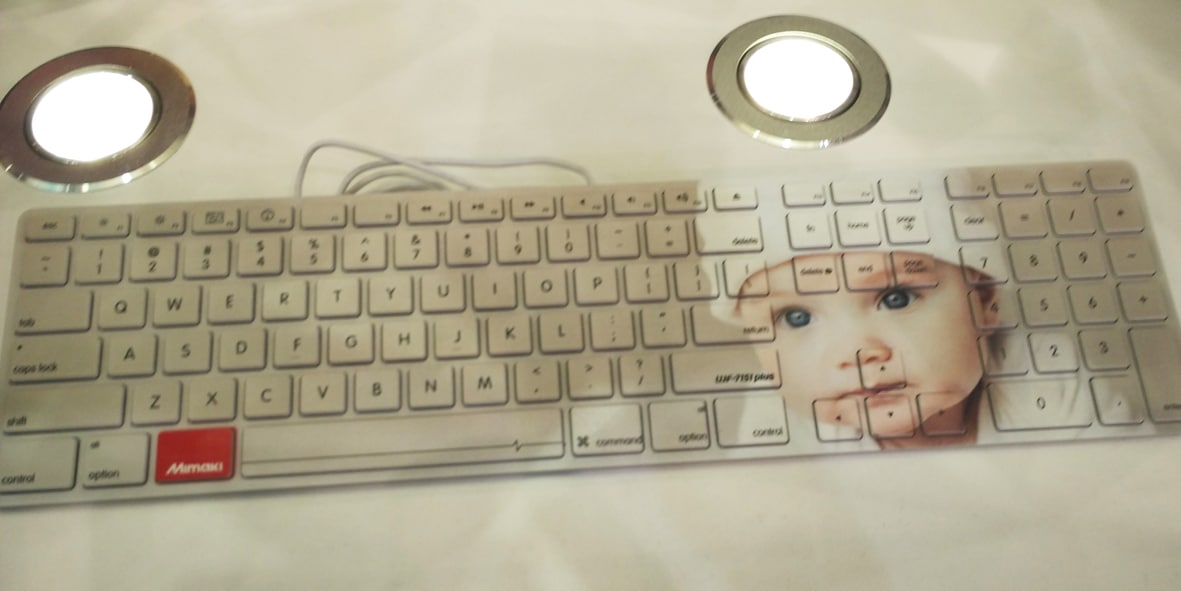
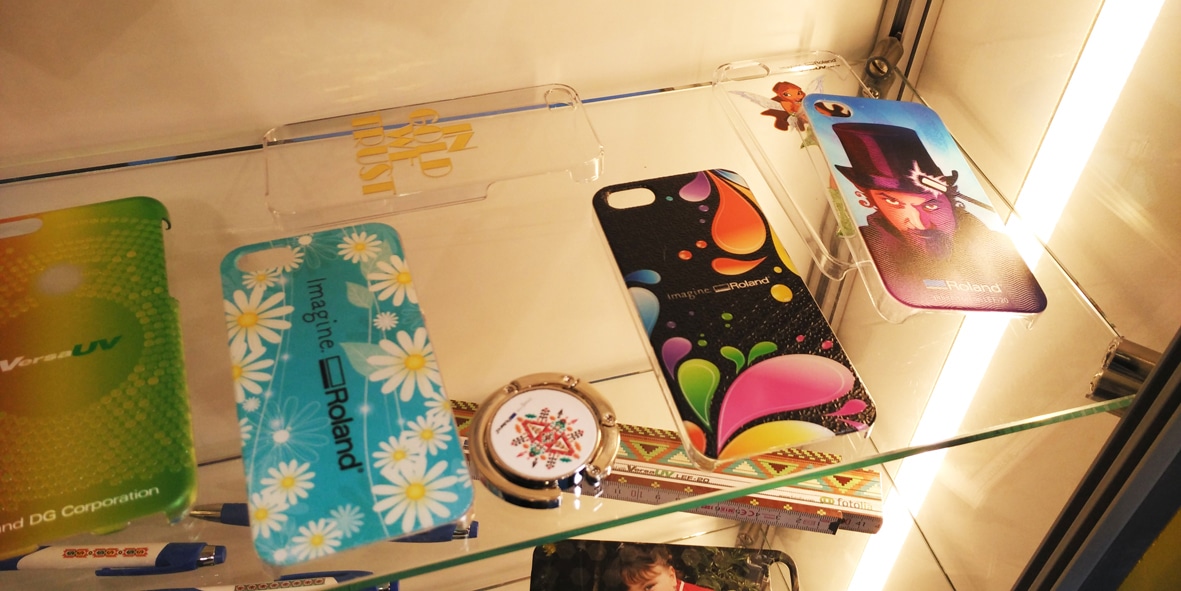
Gift Items (past showcase): we have printed on steel sippers and bottles, key chains, pens, mousepads, a mouse and a keyboard. For a friend’s exhibition of printing machinery, we bought a hundred Rubik’s cubes from a toy shop and printed his invitation on their six faces; we also made a personalised photo jigsaw puzzle. These jobs show what a flatbed can do, but we no longer print on objects. Our printed gifts today are fridge magnets, tea coasters and MDF photo stands, and for bottles we print stickers and labels that are pasted on.
08
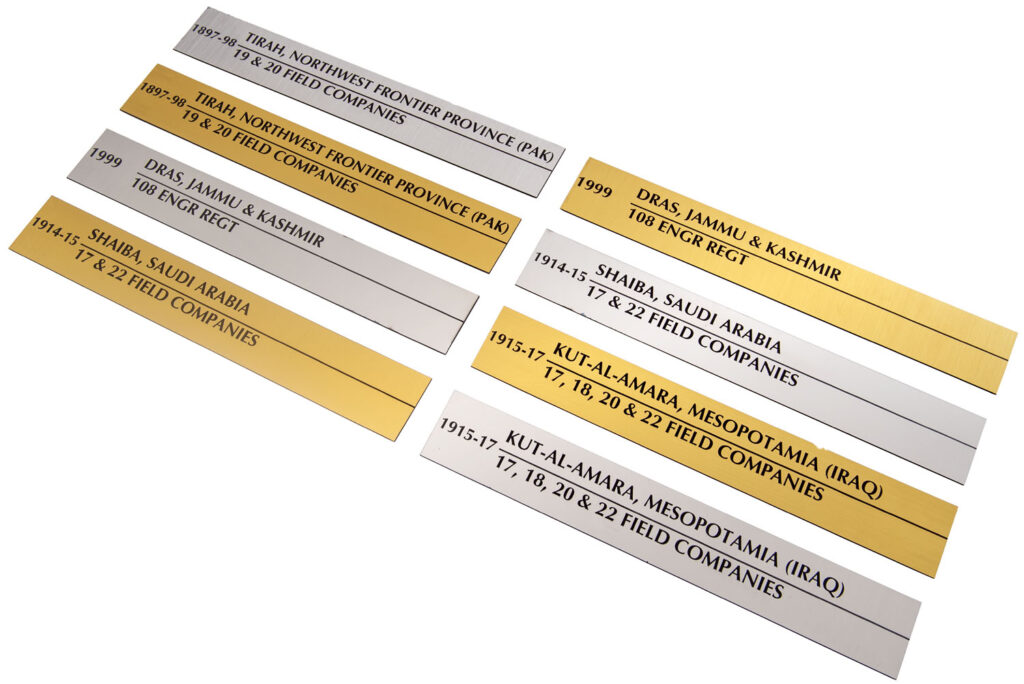
Name Plates: a flatbed can print name plates on wood, acrylic or ACP. Ours are made another way: our gold and silver name plates are laser etched in metallic-finish ABS, with no printing involved.
UV printing is one step in many of the finished products we make, alongside our other printers. The main ones:
Not sure which one fits your job? Email us at [email protected] or WhatsApp us on +91 98232 39733, and we’ll suggest the right product.
These clips were filmed when we ran UV flatbed printers. They show how the technology works on objects. We no longer print on objects or on items clients bring in.
Printing on a round glass bottle (2019). A flat bed can’t hold a cylinder, so a rotary attachment turns the bottle under the print heads as they fire. Past showcase: for bottles today we print transparent stickers and labels that are pasted on.
Tea coasters printed directly on a UV flatbed (2018). The printer lays down white ink first, then the colours, so the design stays bright on the wooden board. That was our old method: today’s MDF tea coasters carry a printed, laminated vinyl pasted on the board.
Mitesh explains the Rubik’s cube invitations. Each cube got a primer coat so the ink would grip the glossy plastic, then a white base layer, then six different designs, and the cubes still worked afterwards. A one-off showcase; we no longer print on objects.
A photo jigsaw puzzle. A photograph printed on a board that was then cut into puzzle pieces: a one-off personal project. Past showcase, no longer offered.
These are current products. UV inks are printed on rolls of vinyl and film, and on acrylic, as one step in making the finished product.
Kiss-cut stickers on a roll-to-roll UV printer. Our Mimaki UCJV 300 prints the stickers and then cuts around each one without cutting the backing, so they peel off easily. See our kiss-cut stickers.
How embossed stickers get their raised feel. The UV printer builds up layers of ink over the design, so you can feel it with your fingertip. See our 3D embossed stickers.
White-ink glass film. A layer of white ink under the colours keeps them vivid on clear film, and white ink on its own can give a frosted look. See our white-ink glass film prints.
Acrylic badges. The design is UV printed on 3 mm acrylic, which is laser cut to any shape and fitted with a magnetic clasp, so there are no pin holes in clothes. See our acrylic badges.
UV flatbed printing is now well established in the print industry, and the machines keep getting bigger: large ones print on planks of wood, floor tiles and big sheets of stone. For printing on objects, the possibilities are limited mainly by imagination.
At Orchid Digitals, UV printing is one step in the finished products we make: badges, stickers, glass films, vinyl graphics and acrylic panels. If you have a question about this article or about a job, email us at [email protected] or WhatsApp us on +91 98232 39733.
Drop us a line. Send us your query. And we’ll get back to you with solutions and answers.
Mitesh lives, mostly for Saturdays.
But when forced to work, you’ll find him heading Orchid Digitals – a printing press in Pune.
If it’s an emergency, try looking for him in the hills behind his house. You’ll almost certainly find him… lazing under a tree, with a book in hand.
2D acrylic light box vs 3D LED letters: how each lit logo sign is built (ACP tray, LEDs, printed acrylic face, side glow), photos of a Cemindia light box from our Pune studio, a side-by-side diagram and how to choose.
Trendani Productions, a record label in Karaikudi, found us online and wanted its logo on a board for its recording room. The file was low-resolution, so we traced it again, printed the blue-to-purple gradient in-house, laser-cut the letters with the colour on, and couriered two boards from Pune to Tamil Nadu.
How we built a hybrid lit name board for Kay Bee Bio-organics: a reverse-printed light-box picture and raised gold acrylic letters with a halo glow on one 3 mm white acrylic plate. Diagram, photos, specs and April 2026 prices, plus the reverse-printed acrylic SOP posters from the same order.