Sign board guide · Orchid Digitals, Pune
Your board speaks before you do
Shop boards and logo boards are what we make most at Orchid. And the question I hear most across my desk is: "Which board is best for me?" Quick hint: there are scores of options, and the right one depends on you, not on the board.
So I wrote this guide. It answers the four questions every board buyer has: what's available, what suits your business, what to put on it, and how to pick a signboard maker who won't disappoint you.
The options
Lit, non-lit, 2D and 3D
A passer-by gives your board
A few seconds
Before you pay, ask your signboard maker for
A detailed proposal
How long it lasts depends on
The materials inside
Step 1 · Narrow it down
What sign board is best for me?
Start with three questions. Each answer cuts the list in half, and after three answers you're down to a short list you can actually compare.

Same board, day and night: gold channel letters that work in both lights.
Trust me, a good vendor can offer you many variants of each answer. But these three questions get you to the right family of boards.
Indoors or outdoors?
A reception wall and a shopfront need very different materials. Outdoor boards face sun, rain and dust every single day.
2D or 3D?
Flat print, or letters you can touch, with real depth and shadow. 3D costs more and is noticed more.
Your options at a glance
Lit or non-lit, 2D or 3D: the four families
Put the answers together and every board on the market falls into one of four families. We make all of them, from simple sunboard prints to premium 3D glow signs, except one (more on that below).
3D and lit: LED glow signs
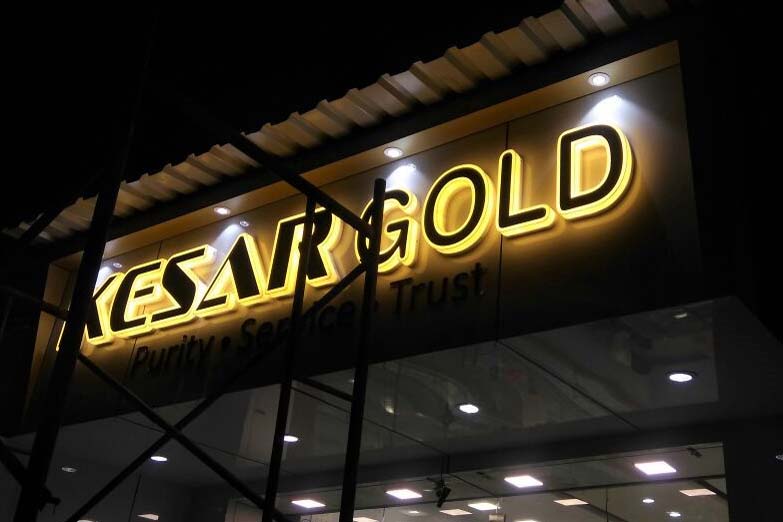
Raised letters in acrylic, ACP or metal, lit by LEDs from inside or behind. Indoors and outdoors.
See the 10 types of glow signs →3D and non-lit: laser-cut letters

Acrylic letters and logos laser-cut on our own machines and fixed on the wall or on a base plate. Indoors and outdoors.
See acrylic sign boards →2D and lit: backlit boards and light boxes
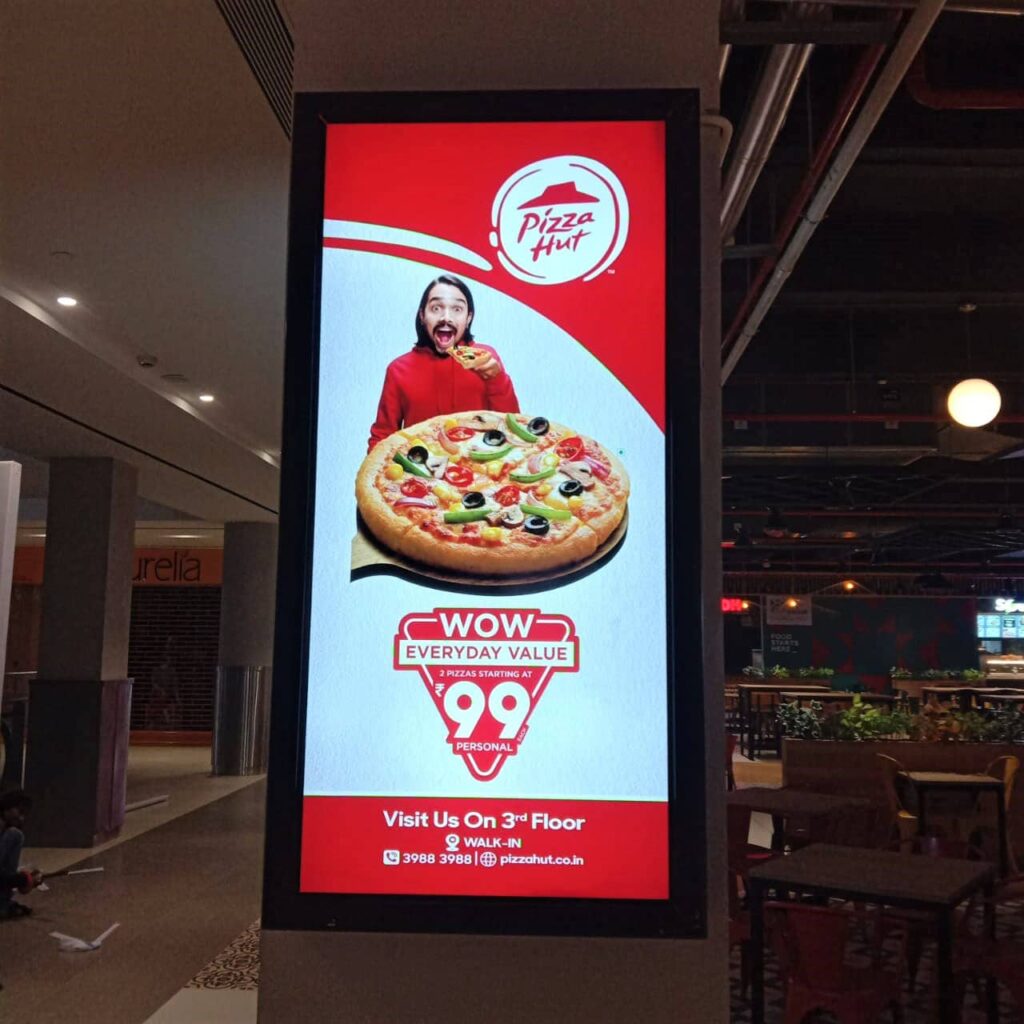
Outdoors, a backlit flex glow sign. Indoors, LED clip-on frames, slim LED light boxes or edge-lit acrylic.
See backlit glow sign boards →2D and non-lit: printed boards

Prints on sunboard for indoor use; on WPC or weatherproof ACP indoors or outdoors. The budget-friendly family.
See sunboard and WPC prints →Lit and non-lit 3D letters both work indoors and outdoors. Indoors, lit 2D can be an LED clip-on frame or an edge-lit acrylic board; for a non-lit outdoor print, ACP panel prints don't rust or warp. You'll also see frontlit flex boards on metal frames all over the city. They're a valid budget option, but we no longer make them.
The 3D lit menu
And then there are the glow signs
When it comes to 3D LED glow signs, the choice is mind-boggling: acrylic and ACP boards, metal letters with LEDs inside, sky signs on top of buildings, channel letters, crystal letters, open-dot LED boards and more.
People often call all of these neon signs. Real neon was glowing gas in bent glass tubes: fragile and power-hungry. Today's "neon" signs are made with LEDs that give the same look and last far longer. So in this guide I'll call them what they are: LED glow signs.
Sky signs
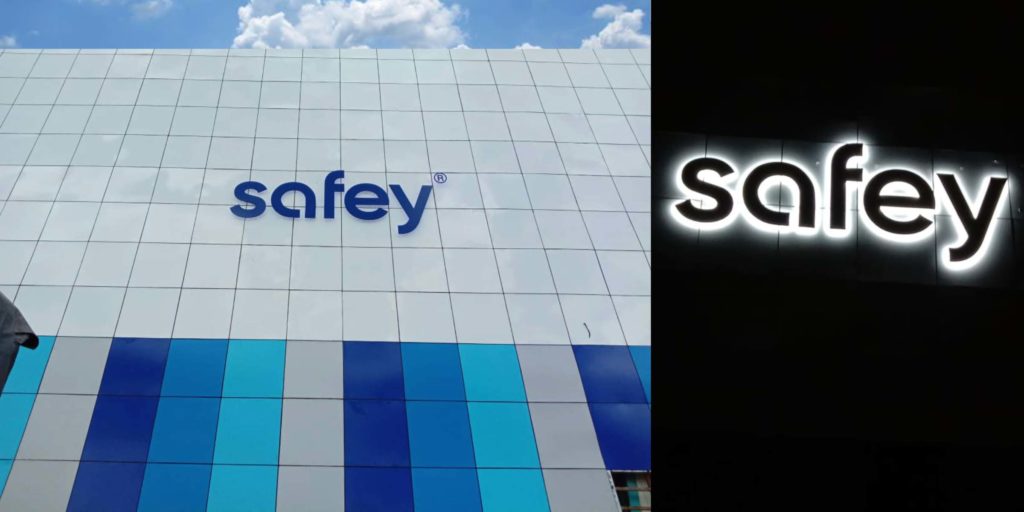
Big letters high on the side of a building, readable from far away.
More about sky signs →Open-dot LED boards
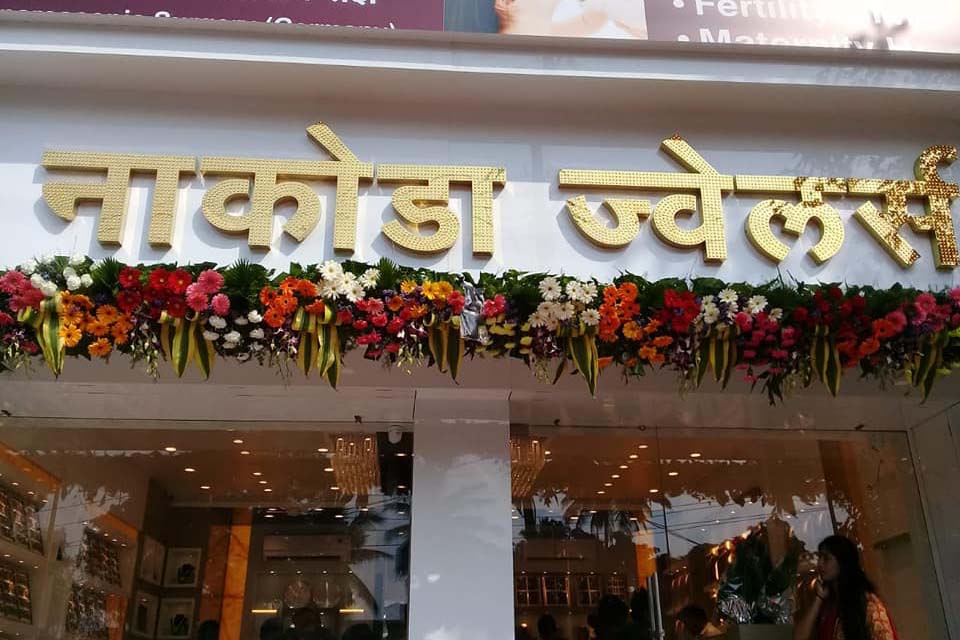
Letters dotted with bare LEDs for a bright, sparkling look.
More about open-dot boards →Metal letters with a back glow
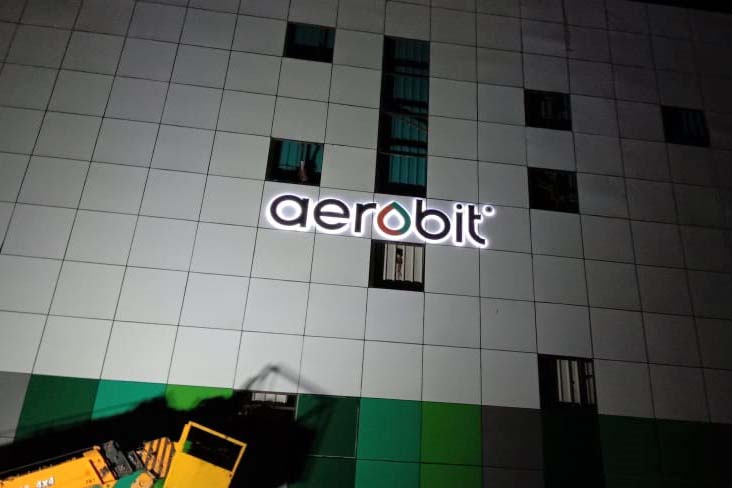
Solid metal letters with LEDs behind them that throw a halo onto the wall.
More about metal letters →Lit acrylic letters
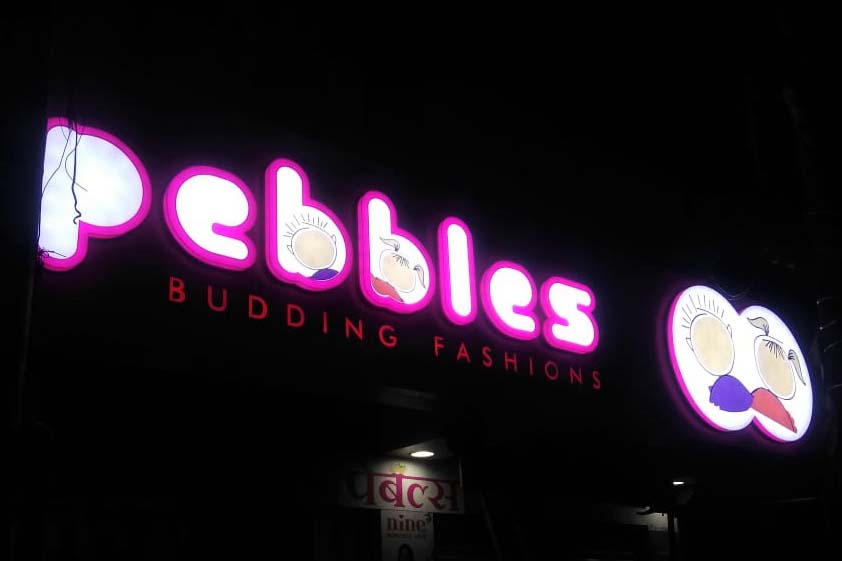
Two-colour acrylic letters lit from inside, like this one for Pebbles.
See lit acrylic letters →There are 10 types in all, including crystal letters, channel letters and in-cut boards. See them side by side, with photos, in our guide to 3D LED glow sign boards.

Step 2 · Think about your customers
Do people find you, or do you need to be found?
This is the question that decides your budget. If your clients already know you, say a well-known doctor, lawyer or chartered accountant whom people come to by referral or appointment, the board only has to say: "You've arrived." A simple, classy non-lit board does that beautifully.
Like this non-lit acrylic logo in a dental clinic's lobby, or a laser-etched gold or silver nameplate at the door.
But if your customers walk past and choose, your board is your best salesman. It works the street 24 hours a day, and after dark only a lit board keeps working. That's where a glow sign earns its cost, and if its letters and logo are cut in 3D, it makes an even stronger impression.
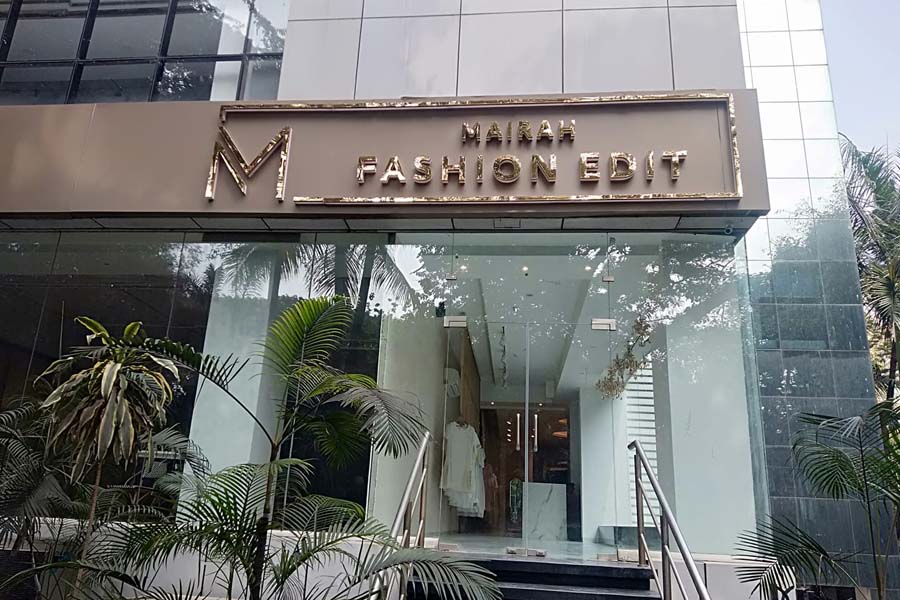
A 3D acrylic glow sign with a metallic finish on a Pune fashion store: the kind of board that makes people stop.
A walk down Laxmi Road
When your board has to win the street
Pune's Laxmi Road is the city's main shopping street: clothes, jewellery, sarees and fashion, shop after shop, side by side. Picture five jewellery stores in a row. A customer walking past has to pick one.

Laxmi Road, Pune: every shop on the street is competing for the same glance.
How do you get her to pick yours? You make your storefront the most inviting one on the street. And on a street like that, a bright 3D glow sign does more than anything else to make people stop and step in.
A good sign board turns a passer-by into a customer.

Namo Jewels
Lit white acrylic letters with gold edges, in English and Marathi, right above the entrance.

Pebbles, MG Road
A two-colour 3D acrylic board running across the whole frontage of their clothing store on MG Road.
Two Pune shopfronts we made boards for. Both boards are lit, 3D and bilingual.
Try it
Not sure yet? Let our board finder shortlist it
Answer four or five quick questions and the finder will suggest the board that fits, with a starting price and a link to the full details. It takes less than a minute.

Step 3 · Plan what goes on it
What goes on your board
Now you know whether you need a subtle board or an eye-catching one. Grab a pen and paper, and let's plan the board itself. Start with the content: make a list of everything you want on it.
Your list
Your company name
Obviously. (Duh.)
Your logo
If you have one. No logo yet? Our favourite Pune designers can create one.
Your products or services
If you sell many things, show broad categories: a supermarket might add fresh fruits, groceries, fine foods and medicines.
Your name in Marathi
In Maharashtra, the Shops and Establishments Act requires shop boards to show the name in Marathi, in the Devanagari script. It's good business too: your board speaks to everyone who walks by.
Your GSTIN
Every GST-registered business must show its GST number on the name board at its place of business. That is a national rule (CGST Rule 18), not a local one.
Phone number and timings
If clients book appointments, as at a doctor's clinic, show your days, visiting hours and a number to call.
Partner apps
A restaurant on Swiggy or Zomato can show their icons; a doctor can show the Practo listing.
Rules change and this isn't legal advice: check the Marathi and GSTIN requirements for your business with your CA or lawyer.
Less is more
Don't make a khichdi of your board
Putting the right information on your board matters as much as leaving out the rest. People glance at a board for a few seconds before deciding whether to walk in. Give them what helps them decide, and nothing else.
Don't confuse or overwhelm your customers with information overload.
Just enough
Everything a patient needs, nothing more
The doctor's name in English and Marathi, the specialty, the timings, the weekly holiday, the floor and a phone number. Read in three seconds.

One thing I see all the time: a full postal address on a shop board. Nobody standing in front of your shop needs your pin code. Put your address on your website's contact page and your Google Business Profile, where people actually look for it.
The layout
Make it readable in three seconds
With the content decided, it needs an eye-catching layout. A professional designer can do this, or you can try an online tool like Canva. Either way, keep these in mind:
In my opinion, the layout is the most important stage of your whole sign board project.
1
Simple fonts
Plain, clear fonts read best. Fancy script letters are hard to read from a distance.
2
Room to breathe
Space the lines and letters well, so every word is easy to read.
3
Icons instead of words
A phone icon instead of the words "Contact number"; a racket and goggles for a sports shop.
4
A picture, if it helps
One picture can say what a whole line of text cannot.
5
Empty space is good
A crowded board hides everything on it. White space makes the important bits stand out.
Many clients worry about materials at this stage. Don't. Concentrate on the content. When you ask us for a quote, we lay out your content for you in the proposal, free, and suggest the right materials. If you need a logo or a brand identity designed, we'll point you to good designers.
Even a note scribbled on a sheet of paper is enough to start. Here's how a rough brief turns into a finished sign:

Illustration: a client's handwritten brief, the layout we make from it, and the finished acrylic sign.

Size
A rough width and height is enough to start
When you ask us about a board, the first thing we ask is its size: how wide and how high. At this stage we don't need millimetre accuracy.
Something like "I want my name and logo on a board about 8 feet wide and 3 feet high" gives us a starting point to place your logo, name and the rest. We take exact measurements later, before fabrication.
Site photo
Send us a photo of the spot
One more thing to send: a photo of the place where the board will go. Making a board is the easy part for us. Installing it can be the hard part.
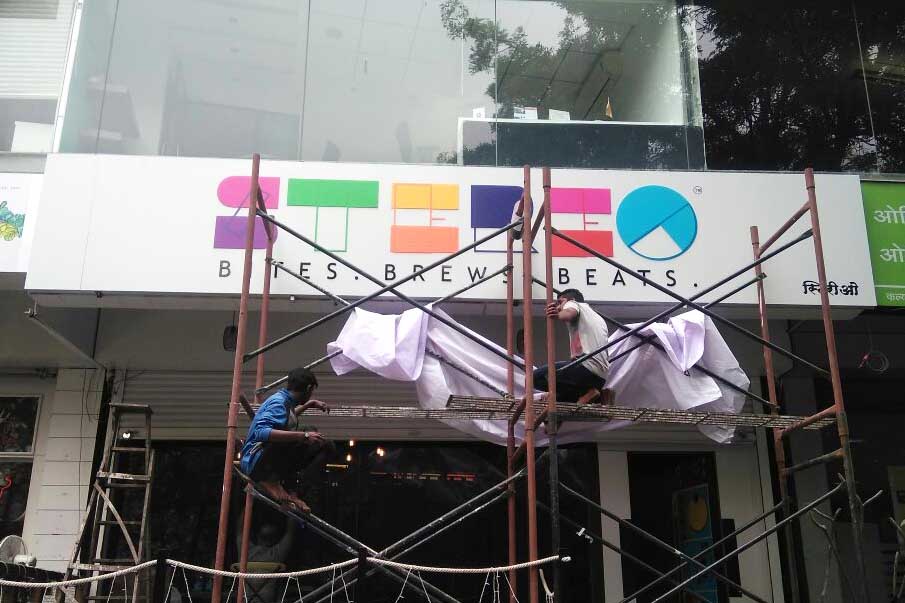
If the board goes high up a building, we may need pahaad (पहाड), the scaffolding our installers stand on, or even a crane. Arranging that can cost more than the board itself.

From a real proposal: the photo our client sent of his reception wall, and the render we made of his new sign on that same wall.
That photo also lets us show you your board before it exists. We place your new sign on your own wall, so you can judge its size, colours and position long before anything is cut.
I've seen a 3D letter board sitting finished in a workshop while the vendor scratches his head, wondering how to get it onto the side of a 10-storey building. It sounds funny. It's not where you want to be as a shop owner.

Four storeys up
The Shaw Group logo on its building facade. This one needed a crane.
On pahaad
Our team fitting a glow sign from scaffolding above a shopfront.
A site photo tells us before we quote whether we need a ladder, scaffolding or a crane.
Step 4 · Get it on paper
The proposal: what you should get before you pay
Once a signboard maker has your content, size and site photo, ask for a written proposal: how they'll turn your inputs into a board, with the layout, the size, the materials and their colours, and the full specifications.
This is where so many vendors falter. Instead of a clear document, you get verbal promises about how the board will look. You can't picture what you're buying, and once the board is made, it's too late to change it.
"Give me six hours to chop down a tree, and I will spend the first four sharpening the axe." Often attributed to Abraham Lincoln.
No job, from a space shuttle to dinner on the table, goes well without a plan. So for every glow sign we make a detailed proposal, free, and start fabrication only after you approve it. Here's what's inside, page by page, taken from real proposals we've sent our clients.

Proposal · What you send us
Your inputs, in one place
The proposal starts with what you gave us: your logo, photos of the site and rough measurements. Here the client sent a logo made with an AI tool and photos of her wall, with the width marked in green.

Proposal · Page 1
The layout
The first page is the design: where the name, logo, tagline, contact details and any pictures go, for the most visibility and impact. The aim is a board that makes people want to walk in.

Proposal · Page 2
The dimensions
The second page gives the overall width and height of the board, and the height of the logo and the letters. Share it with your interior designer or architect saheb and check it together.
Letter height decides how far away your board can be read: an 18-inch letter is seen from much further than a 12-inch one. Sizes also drive the cost, so look at this page carefully.

Proposal · Page 3
Materials and colours
Modern boards use materials with confusing names: acrylic, ACP (aluminium composite panel), LED modules, coloured vinyl, SS (stainless steel) letters, WPC (wood plastic composite). So this page shows a picture of every material and where it goes on your board.
Every material comes in many shades, so we write down the colour codes too, and the colour of the light. You can check all of it against your brand colours before anything is cut.
Warm white
about 3,000 K: a cosy, yellowish glow
Natural white
about 4,000 K: neutral, neither warm nor cool
Cool white
5,000 to 6,500 K: crisp, bright, bluish white

Proposal · Page 4
Specifications and price
A 3D glow sign is an assembly of many materials. This page shows how they come together: how thick the board is, how deep the 3D letters are, what's flat, which parts light up, and whether a letter glows only from the front or from the sides too. We list the brands and thicknesses of the materials as well.
Then comes the price, with what's included (such as transport and installation) and what isn't (such as a crane or pahaad for a board high up).

Proposal · Page 5
The site render, by day and by night
Remember the site photo? We put your new board onto it, in a day view and a night view, so you can see exactly how it will look on your building before it's made.

And the real thing: the same gate board, installed. Compare it with the render above.
Why it matters
Why the planning stage pays off
A detailed proposal makes the whole job transparent. You can compare one signboard maker's offer with another's, line by line, instead of comparing promises. Curious how we do it at Orchid, from the site survey to the fitted board? Read how we work with you on a sign board.
You see it before it is made
Layout, size, materials and a render: no surprises when the board arrives.
You know what to ask
If a vendor can't give you these details, ask for them. If he still can't, look for another vendor.

Step 5 · Check the materials
What a glow sign should be made of
The first question every client asks is the cost. And like most things in life, the answer is: it depends. I can make you a board for ₹25,000. I can also make the same-looking board for ₹50,000.
The difference is the materials. Many vendors use cheap raw materials, and the result is a shoddy board that fades, cracks or breaks within a year or two.
Your board is the first thing your clients see, and it will stay up for years. Good materials give you years of bright, trouble-free service. So here's what to discuss with your signboard maker before you say go.

Materials · The frame
Aluminium, not iron, wherever possible
Every board is built around a frame, and to save money most vendors use iron: cheap MS pipes or rods. Outdoors, iron rusts. It shortens the board's life, and the rust stains spoil its looks. Look at shop boards on your next shopping trip and you'll spot the brown streaks.
Wherever possible, we use aluminium sections. Aluminium is light, it doesn't rust, and an aluminium frame behind the ACP lets us give the board a neat, folded and creased finish at the front. It costs a little more, and lasts much longer.

Illustration: how an ACP sign board looks from the back when it is built on an aluminium section frame. Light, rust-proof and neat.
There's one exception. When a frame has to be welded or fabricated on site, for example a structure that hangs a board from a ceiling, we use a metal pipe frame, because aluminium can't practically be welded that way. That's what held up the Yashogandharva sign.

Materials · The LEDs
Insist on high-quality LEDs
The biggest cost in any glow sign is its LEDs. We use hundreds, sometimes thousands, in a single board. So a vendor who switches to cheap LEDs saves a lot of money, and you pay for it with a dull, uneven glow.
Ask your signboard maker which brand of LEDs he'll use, and check its reviews. At Orchid we use high-end, industrial-grade LEDs that are waterproof and weatherproof and keep glowing brightly for years, and we name the brand in the proposal.

LED modules
Small modules, big difference
LED modules come in white, warm white and colours (RGB). Good ones stay bright and even for years; cheap ones fade and flicker.
Materials · How many LEDs
Count the LEDs in your board
The LED modules inside a sign are small: a three-LED module is just 14 mm x 70 mm, and a two-LED module is even smaller. They sit in the hollow space inside a 3D letter and light it up from within.
Take two letters of the same shape and size. Put fewer modules in one, or space them badly, and it glows dimmer, with bright spots and dark patches. How bright and even your board shines depends heavily on the quality of the LEDs, how many are used and how evenly they are spaced.

Illustration: the same letter twice. Enough LEDs, evenly spaced, on the left; too few, badly spaced, on the right.
Next time you walk down a shopping street, look for boards with an uneven glow or dark spots between the bright parts. That's usually a vendor saving on LEDs. So ask how many LEDs your board will have.

Materials · The power supply
The power supply (driver)
One more part decides how bright your board is: the power supply, or driver, that feeds current to the LEDs. Use an industrial-grade power supply with the right wattage for an even, bright glow.
And make sure it's exterior-grade and weatherproof. A power supply that gives up in the monsoon or the May sun switches your whole board off.
To sum up
Plan first, then buy
Your board represents your business to everyone who passes by, and it will stay up for years. It's a real investment, and it's hard to see what materials a vendor actually puts inside. So set aside some time to plan it.
Pick the right kind of board for how your customers find you. Decide the content from your customer's point of view: clear, quick, no khichdi. Then choose a signboard maker who gives you an attractive design, explains the materials and puts it all in a proposal. Learn to tell good materials from cheap ones, because they decide how bright your board looks and how long it lasts.
See the planning in action
Case study
Suspended channel letters for Yashogandharva
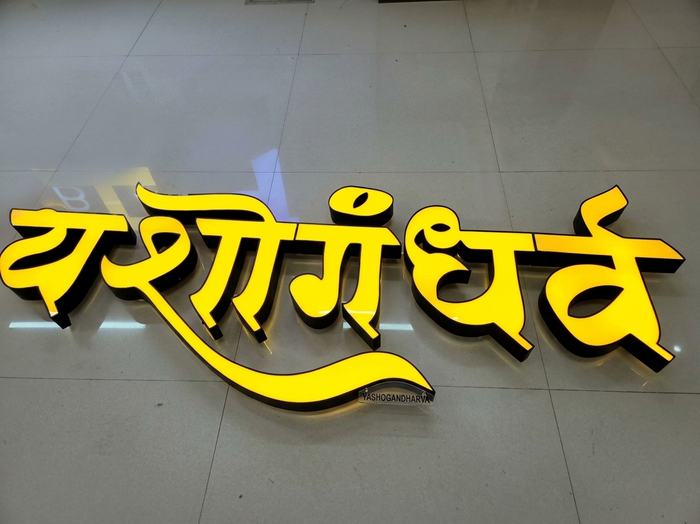
No wall, no frame and five days: a building name hung from the ceiling.
Read the story →Case study
A gold acrylic wall logo for Her Table
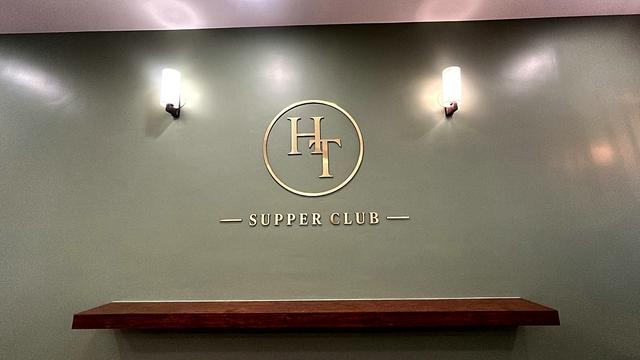
From an AI logo to a two-layer acrylic logo with no visible screws.
Read the story →Your turn
Planning a sign board?
Send us your logo, the content, a rough size and a photo of the site on WhatsApp. We'll send you a free proposal.